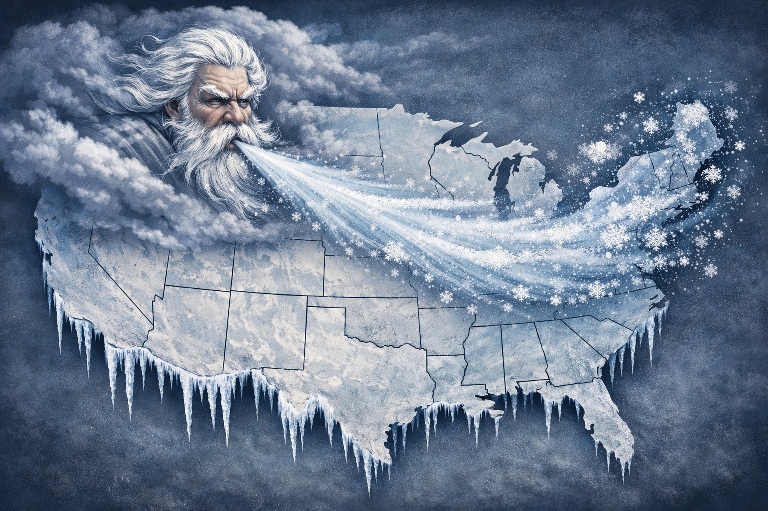
Winter Weather Woes
Two winter-weather-related stories caught my attention in late January and early February 2026, in the form of a paralyzing storm that shut down much of the US; and a beloved folk tradition come to life in a prognosticating rodent.
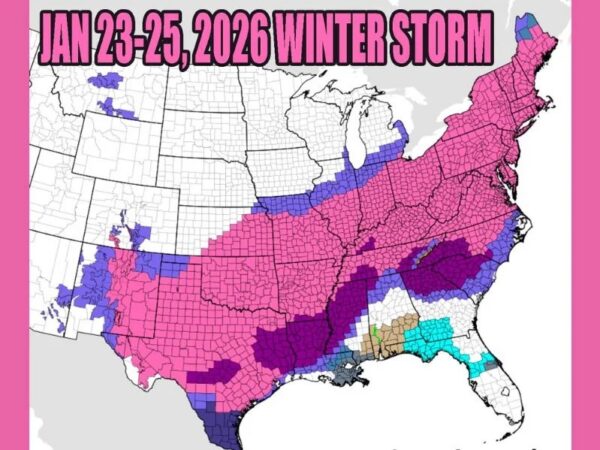
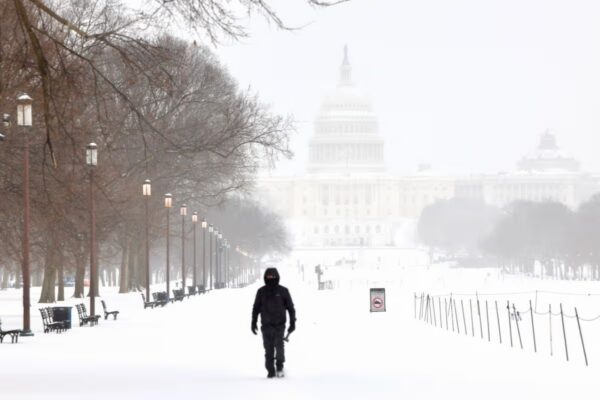
Over the last full weekend of January 2026, a massive winter storm made its way across most of the continental United States, dumping up to two feet of snow in its wake, bringing traffic to a standstill and having a literal chilling effect on commerce, with temperatures well below freezing. Many regions also experienced heavy ice accumulation resulting in widespread power outages. Winter storm warnings blanketed the country from Texas to Maine, with more than 200 million Americans affected, almost two-thirds of the population.
A forecaster with a savvy weather eye to the astrological skies would have noted a conglomeration of celestial factors which presaged no good. Mercury at 11 Aquarius is the planet most associated with the weather, and its conjunction with Mars (3 Aquarius), Pluto (4 Aquarius) and the Sun (7 Aquarius) indicates a focus (Sun) on an extremely powerful (both Mars and Pluto) weather system (Mercury) that would be making news (also Mercury). Pluto also has an economic effect, being the planet associated with billions of dollars; estimates of the cost in damage from the storm vary from $105-115 billion. Squaring this cosmic pileup is asteroid Iceland 110299 at 9 Scorpio, suggesting the freezing conditions and ice accumulation.
The precise nature of the weather involved can be seen in a remarkable triple conjunction of three asteroids which relate to winter storms, which is the solar grouping. All three appear at station, a crucial moment in their orbital cycles which focuses and strengthens their effects and promotes far-reaching manifestations. These are: asteroids Storm 12182 at 8 Gemini, with an obvious application to the story; Schneeweis 161546 at 11 Gemini, a German term meaning “white snow;” and Snowdonia 129092 at 14 Gemini, calling to mind snowy conditions. These cluster about the US’ natal Descendant at 12 Gemini, opposing its 12 Sagittarius Ascendant, specifying where its effects would be most felt.

As well, a Grand Cross of asteroid America 916 at 28 Leo opposed Damocles 5335 at 2 Pisces, squared Uranus at 27 Taurus and asteroid Winters 5111 at 26 Scorpio speaks to the looming threat (Damocles) of winter weather (Winters) in the US (America), with the potential to adversely impact power grids (Uranus, ruler of electricity). Uranus also rules flight, and the storm caused more than 11,400 flight cancellations, leaving in excess of 820,000 customers without electric power.
The storm’s essentially inimical nature, with extreme cold prompting hardship and deprivation, is imaged in a square from Saturn at 28 Pisces (indicating hardship, loss) to a grouping of asteroids Sturm 31043 at 24 Sagittarius (German for “storm”), Nemesis 128 at 26 Sagittarius (an enemy or opponent), and Frostia 854 at 1 Capricorn, (suggesting frost and cold conditions).
IT’S GROUNDHOG DAY … AGAIN
The tradition of fair weather on February 2nd (known variously as Imbolc, Candlemas, and Groundhog Day) presaging a long hard slog of winter ahead is a broad one. An old English epigram asserts, “If Candlemas be fair and bright, winter will have another flight,” that is, it will continue cold and stormy. That may sound counterintuitive – after all, why should good weather signal bad weather still to come? – but the German tradition makes it plainer. For persons of German descent, including yours truly, the mid-winter weather prognosticator is the hedgehog, a hibernating mammal whose nearest relative in the New World is the groundhog. As winter trickles toward spring, he pops his head out of his hole to assess the situation. If it’s sunny, and he sees his own shadow, he becomes frightened and retreats into his burrow for another six weeks (not coincidentally, a timeframe coinciding with the first official day of spring). In contrast, if the skies are overcast, he leaves his warm nest without trepidation, and an early spring is predicted.
In Pennsylvania, where German immigrants dominated much of the demography in Colonial days, the tradition is very much alive, in the person of Punxsutawney Phil, a groundhog who makes his annual appearance every February 2nd, to much fanfare (1). (Readers are likely familiar with the 1993 classic “Groundhog Day,” starring Bill Murray, filmed on location.)

This year, with feet of snow still on the ground from the recent blizzard, Phil took a quick look around, and then expressed, in groundhogese, to Punxsutawney’s mayor (who translated), that he did, indeed, see his shadow. Six more weeks of winter wasn’t exactly a hard call given local conditions, and Phil will likely be proven correct.
Surely such a quaint folklorish carryover can’t have a reflection in the skies! Or can it?
Phil made his somber pronouncement at 7:25 AM EST, under a rising 13 Aquarius Sun squared by a triple conjunction of asteroids Iceland 110299, Schadow 5265 and Rodontia, at 10, 7 and 8 Scorpio respectively. Iceland conjures images of cold, snowy landscapes, Schadow is an alternate spelling of shadow, and Rodontia references rodents (designated Rodentia), of which mammalian order the groundhog is a member.

Personalizing the event to Phil himself, we see asteroid Philippa 977 (feminine form of Philip, for which there is no exact match) at 15 Virgo conjoined asteroid Schade 315186 at 21 Virgo, an alternate spelling of shade, AKA shadow. As well, asteroid Philia 280 at 14 Cancer, another “Phil” referent, conjoins Jupiter at 17 Cancer, a nod to Phil’s recognized status as “the most famous groundhog in Pennsylvania,” with Jupiter ruling fame and celebrity. More to the point, Philia is also sesquiquadrate to asteroid Winters 15111 at 27 Scorpio, linking him directly to the season, and semisquare Uranus at 27 Taurus. While it was hardly a shock (Uranus) that winter (Winters) would continue, Phil is to be honored for discharging his duty so faithfully.
The annual ceremony is the focus of all eyes for the region, an attribute of the Midheaven, and we find Winters conjoined the 2 Sagittarius MC. Also here is asteroid Jefferson 30928 at 9 Sagittarius, with the town of Punxsutawney located in Jefferson County.
Notes: (1) Phil isn’t alone in his role as groundhog forecaster, but he has hegemony over other regional pretenders, such as Buckeye Chuck in Ohio, Staten Island Chuck in New York, and Wiarton Willie in Canada. In the American South, where groundhogs are rare, opossums such as Birmingham Jill in Alabama do their best to compete, while in Texas they resort to other animals, such as Bee Cave Bob, an armadillo, and Big Al, an alligator.
Title Image Credit: drawn by ChatGPT


One comment, add yours.
Laurien
Loved the weather story! That triple conjunction of wintry asteroids sure did the trick! And now I finally understand Groundhog Day! Thanks Alex! Loved the groundhog ICE meme too!