Garden Glimpses: Waning Summer, Waxing Fall
Frankly, August can be a bummer in the garden. The floral exuberance of high summer is past, and autumn’s bright colors aren’t yet on the horizon. For a more traditional gardener, August presents unique challenges in finding plant material that will offer bloom, without relying on expensive annuals that need to be replaced yearly.
But for yours truly, with 60-70% of the garden populated by native perennials, the situation isn’t quite so dire. It’s taken six years, but my vision of a native meadow with continual revolving bloom is finally taking shape.

The daylilies are the last of the major “import” collections to bloom, and from their waning in early August, natives take control. Echinacea (purple coneflower) and rudbeckia (Brown-Eyed Susan) are still vigorous as the eighth month begins, and represent a sort of hybrid between cultivars and natives. Echinacea is native to my area, and was originally brought onto the property from local fields by my father, though I’ve allowed it to spread far wider than he did. Perennial rudbeckia is not native locally, but thrives in similar conditions, and a few initial plugs have again self-sown and populated across the landscape.
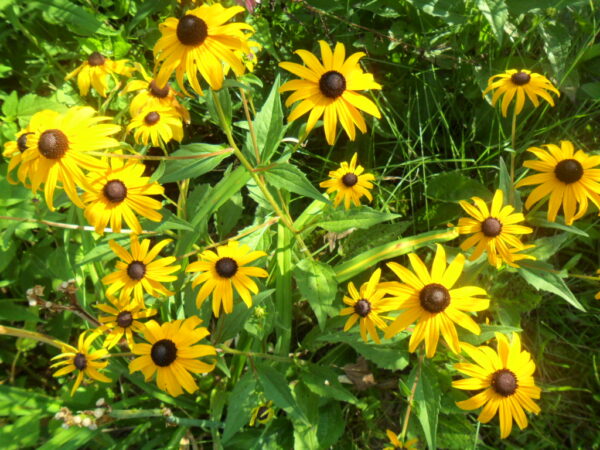
Echinacea burns out first (though will offer some small side blooms randomly until frost), but rudbeckia is just getting up to speed as the daylilies wave goodbye, and will dominate the first half of the month with its rich yellow blossoms dotted in brown.
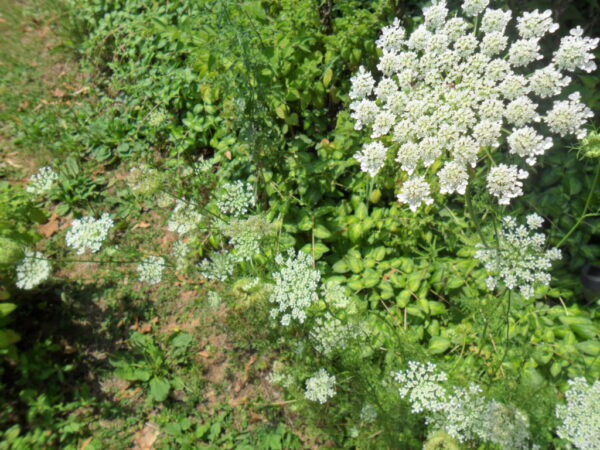
Standing right alongside is the first of what I would term the late-blooming “true” natives – Queen Anne’s Lace. That’s also a bit of a misnomer, however, as “native” QAL, also known as “wild carrot,” is actually a garden escapee imported by early European settlers (who prized it for its traditional medical usages, as a digestive and diuretic aid), and so is properly characterized as “naturalized” in my region, not native. But the function is the same – you don’t buy ‘em, you don’t planet ‘em, they just muscle in and you tolerate or eradicate them, at your preference.

My preference is to not just tolerate, but encourage these cheerful “platter” florals, with broad discs of off-white blooms composed of hundreds of individual blossoms. As they age, these brown and curl inward into upright clusters, giving rise to another regional name for the species, “bird’s nest.”

Queen Anne’s Lace commences bloom in late July and thrives well into late August, making an attractive, if messy cut flower (if left too long in water, the minuscule petals will drop and “litter” the tabletop with a dust-like material).
There’s one more native that straddles the gap between mid and late summer: Joe Pye Weed. Although I purchased both of mine, some varieties are native locally, but too tall to be appreciated in my garden. So I resorted to a local native plant nursery for a “dwarf” variety of “just” 7 feet in height. Sturdy and unflappable, Joe Pye sports a bloom head that looks like a fine filigree of dusty rose to pale purple fuzziness, a truly unique flower. Hard to believe these behemoths die back to the soil and resprout annually – you can practically watch them grow! Pollinators enjoy it, and the flowers dry nicely. These come into their own in late July and bloom into mid-August, adding a touch of soothing cool color to an otherwise fiery landscape.
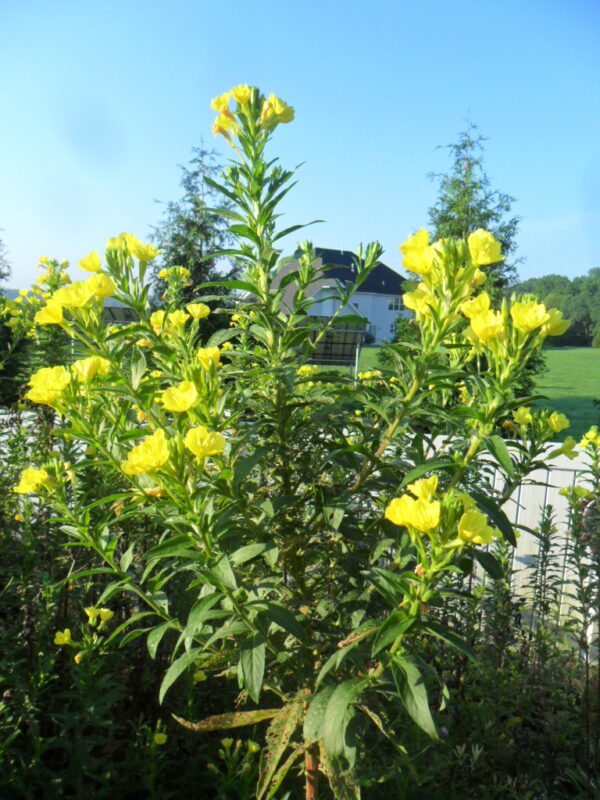
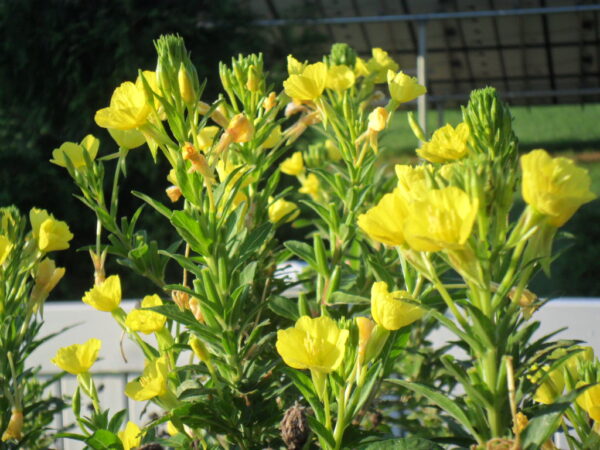
Next in the native wildflower parade is evening primrose. These tall branching plants can exceed my height, and my share of them began with a single self-sown volunteer five years ago. Slowly spreading into a colony on the far slope of the sandmound, this year they exploded, ranging across the south side of the structure, jumping the path into the central bed, and even sending a few ambassadors into the north slope area.
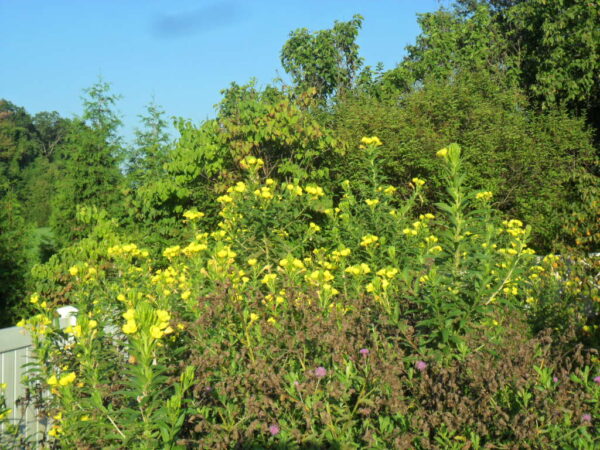
As its name implies, evening primrose opens at dusk, and only persists into the mid-morning, when its one-day-only blossoms fade and drop. An important species for nighttime pollinators, its bright buttercup yellow blooms help fill the floral gap from early to late August with vibrant color.

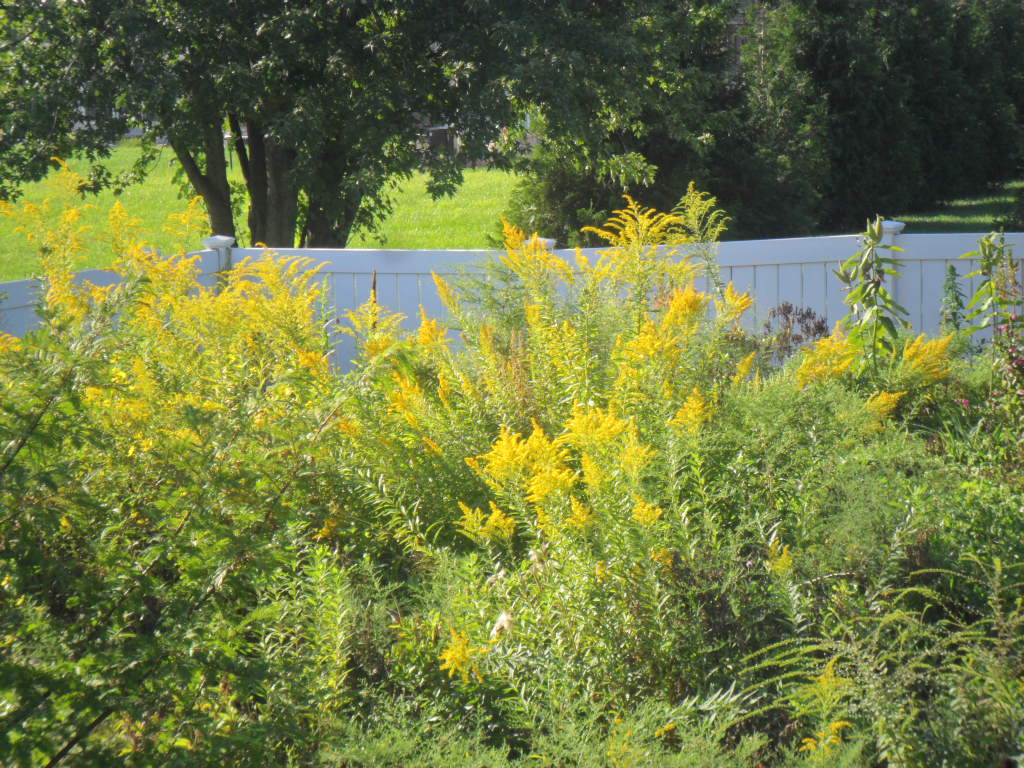
Just as evening primrose begins to fail, goldenrod rushes into the breach. There are many species of goldenrod, and I can point to at least four different varieties in the garden, based on appearance and bloom times, though I have never formally identified any of them. One can tell them apart by the style of the bloom head, the height of the overall plant, its stability (does it flop or remain erect after a rain?), and how early it comes into flower.
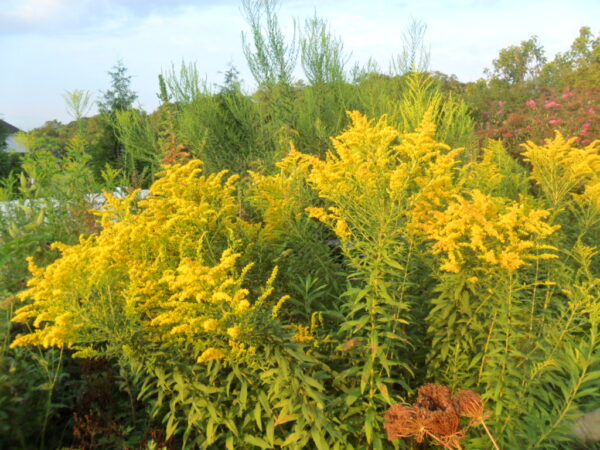
Some goldenrods have smaller, fuller, more compact bloom heads, resembling a mop; some have a more aerial, branching structure, resembling a broom; and others are composed of multiple, upward-arching small branches, almost like ribs of an inside out umbrella. Of these, the ‘umbrella’ type is tallest and sturdiest, and blooms latest; the mopheads thin-stalked and most likely to flop, and bloom first; while the mid-season brooms can go either way, but are better in groups, where they support each other. A fourth, named, variety, is one I bought and planted myself – “Fireworks,” which has lateral branches of blossoms, as opposed to a single bushy head, emerging along the top third of the plant. All have a Rumpelstiltskin “spun gold” quality to their color, a rich, densely packed covering of tiny deep yellow florets clustering closely on the bloom stems. The goldenrod season, from start to finish, can last a good six weeks, and if picked at peak, the flowers dry well for arrangements.

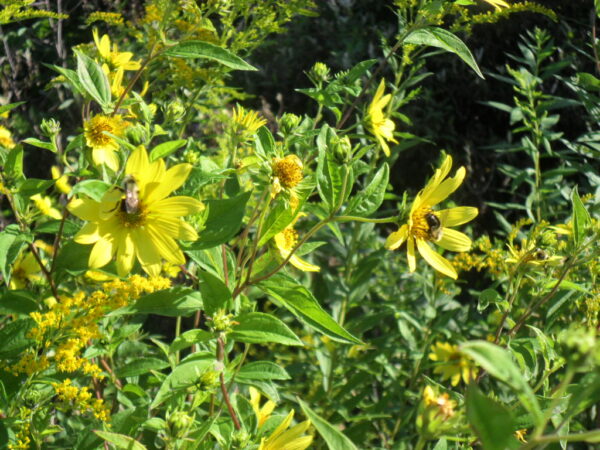
Helianthus often accompanies goldenrod in bloom. A type of perennial sunflower, Lemon Queen is my variety, with daisy-like flowers in soft, buttery yellow, having chocolate brown centers. I also bought this cultivar, and my two initial plants have started to spread beyond their compact, circular colonies. It has proved a fickle pant, some years thriving, and others rather sparse; 2026 seems to be a middling year, as the late August bloom begins. Lemon Queen is another pollinator magnet, especially beloved of wasps and small bees.


Another purchase that provides late summer interest is turtlehead, also a “colony” type plant, roughly three to four feet high, growing in a mass some five feet across, which produces multiple spikes of bright pink blossoms, reminiscent of snapdragons, blooming in clusters from bottom to top. After the first week or so of flowering, turtlehead is a plant best enjoyed from a distance, for its color pop, as it doesn’t age well, with a tendency to retain unsightly spent blooms that mar its beauty up close.
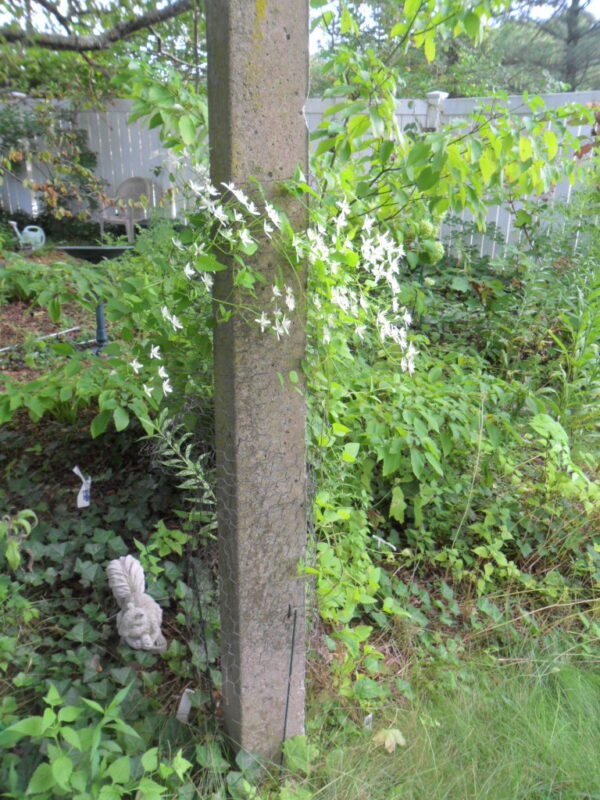
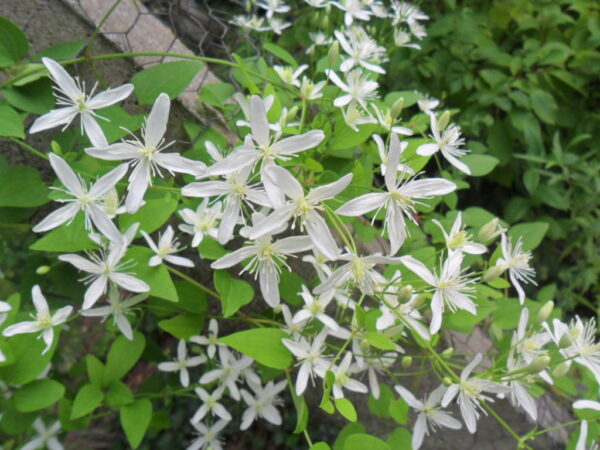
My autumn clematis, with its small white starlike flowers, is three years old now, clinging to an old cement wash post, and this is the first significant bloom it has given me. My parents had one for decades, that put on yards of growth very year, but it was lost, along with much of their outer garden, when the sandmound was installed in 2010. It was nice to bring a replacement to the property, but increased upper canopy growth in the intervening years means that light patterns have changed, and the new plant no longer receives as much sun as it wants to thrive. It will never be the leviathan my parents’ was, but is coming along well.
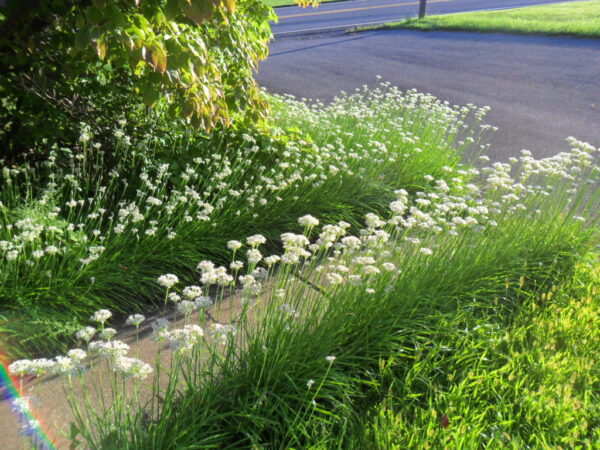
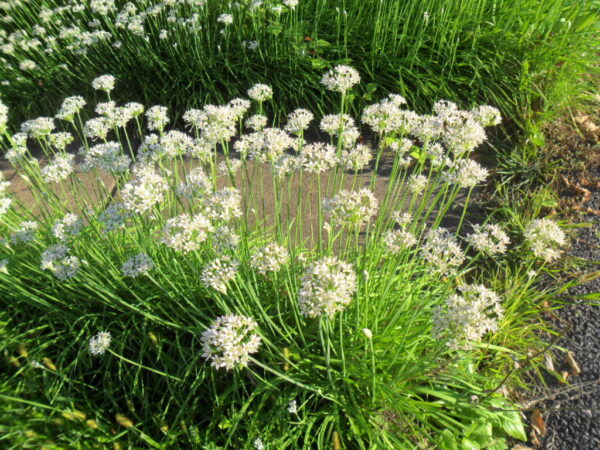
In the front of the property, I eagerly anticipate the season for my garlic chives to bloom, late August into September. Originally a small patch gifted by me to my father, and planted in the small circular bed under the Chinese dogwood, these have spread far and wide, until they extend along approximately two thirds of the path that leads from the driveway to the front door, lining both sides. An ordinary flat-bladed grasslike clump for most of the year, in late summer they sprout 18” high stems topped with flat discs of tiny white blooms, absolutely covered in pollinators of every description. They look like the whitecapped rapids of a river flowing down the gentle slope from the front porch, stunning in blazing white. Their blossoms dry like delicate paper, and enclose small green buds resembling capers, that form into coal-black seeds, making them attractive well after bloom. With their sturdy stems, they can endure quite a bit of winter damage, so I delay cutting them back until spring arrives, as their erect stems provide a perfect marker for where to shovel the path in deep snows.
Goldenrod is at peak as August transitions into September, the last true summer-flowering native in my garden. But there are signs that autumn blooms are not far off. Native aster is budding up, white snakeroot is just starting to unfurl its fuzzy clusters, and here or there a tinge of color strikes in foliage.
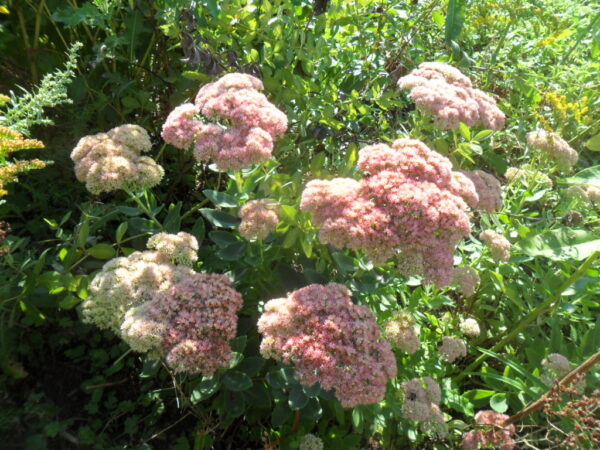
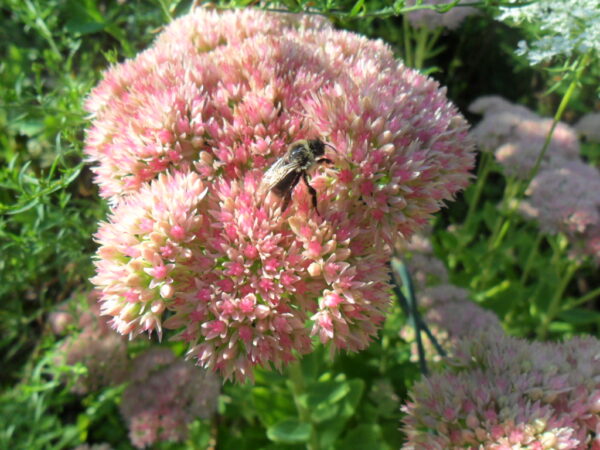
My fall-blooming sedum has started to open its delicate pink bloom heads, a sure sign of autumn’s approach. Sedums come in a wide variety of colors and sizes, but I find that the classic Autumn Joy does best for me. It’s a drought-tolerant reliable performer, and once established, provides a lovely pastel counterpoint to the bright whites and yellows of the late summer season.
One plant I’m especially interested to see is a blue lavender aster I purchased three years ago. Tiny when it arrived by mail order, that first year it barely held its own, and in the two seasons to follow, it remained small and oddly shaped, spreading out low from its center, almost like a creeper. I have a major problem with invasive mugwort in that area of the garden, and this would repeatedly overgrow and shade it, to the extent that last year, I thought I’d lost it entirely, only to find it had somehow lingered beneath its unwanted canopy, when I completed my fall mugwort cleanup.

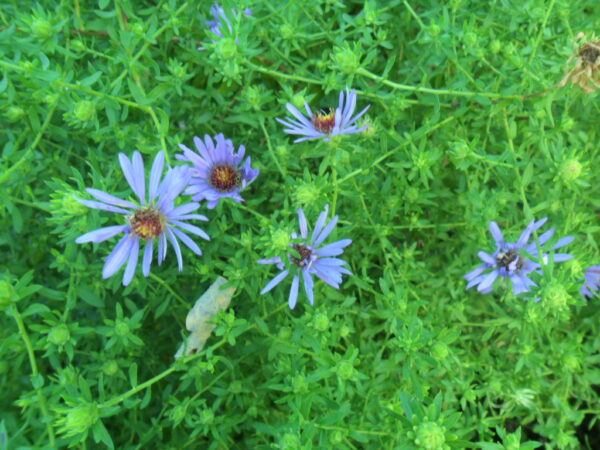
This year, it finally performed as expected, mushrooming suddenly into a bushy mass, about three feet across and two feet high, and now peppered with buds, which are just beginning to open as September dawns. Its increased height has made it easier to identify its location and keep the mugwort at bay, so I’m confident of a good show in the weeks to come.
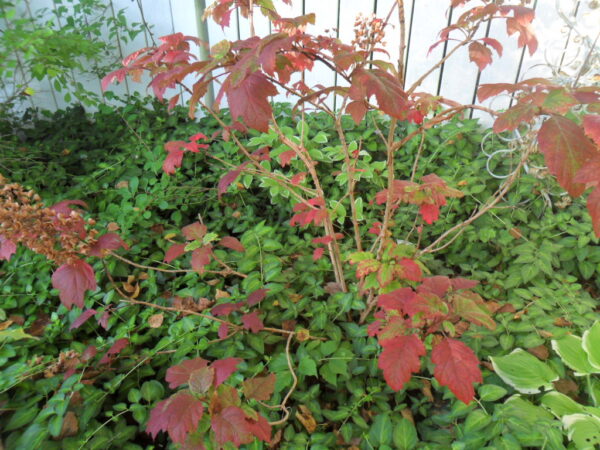
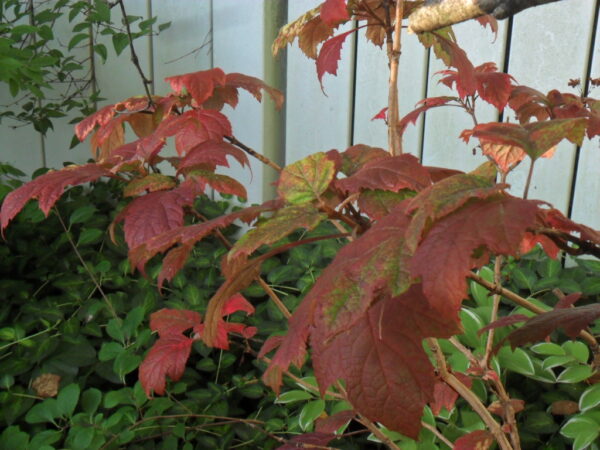
Incipient autumn is also evidenced by the foliage color change on my Snowflake oakleaf hydrangea, already arraying itself in stunning tones of orange-red and burgundy, weeks ahead of schedule. Sadly, this early transformation may be a sign that Snowflake, which has struggled all season, may be on its way out. Only time will tell.

Also turning early, my black locust, which is rapidly yellowing, the first of the deciduous trees in the yard to don its autumn robes, to be followed by the fire-toned Chinese dogwood, the purply-red Pagoda dogwoods, and the bright yellow Norway maple. Before too long, the native asters will hold sway in the garden, and with any luck, I’ll have a few chrysanthemums to admire, from new mail order purchases that I have warehoused in pots, to see how they do before attempting to dig them into my dense clay soil. Left to themselves, they’d likely have thrived, but a hungry varmint chewed them down early on, and though resprouted, I’m not sure they’ll be mature enough to set buds and bloom before frost.
Regardless, there are mums to buy at roadside stands, along with pumpkins, gourds, hay bales and corn shocks. Fall is almost here!


4 comments, add yours.
rosemary
Alex, Thank you for sharing photos of your beautiful flower garden. I always
enjoy seeing and admire! Today’s email was timely as it’s my 81st birthday!
So to see all the bright colors lifted my spirits on a rainy September day.
edna
It’s really looking lush these days. I’m green with envy.
Ellen
Alex, it is always a joy to see your garden bloom and change over the seasons.
Alaine Grant
Beautiful photos…I learned a lot…Thanks for sharing Alex!